Ich sah aus dem Fenster in den samtblauen, leuchtenden Nachhimmel hinter den gedämpften Partylichtern, die sich in der Scheibe spiegelten. Unsere Gestalten reflektierten sich in der Glasscheibe wie transparente Schatten von morgen. Wir waren schon heute unsere eigene Vergangenheit. Wann würde der Regen kommen? Machte es überhaupt einen Unterschied, ob eine nukleare Staubwolke in 10.000 Metern Höhe über uns hinwegzog, oder der atomare Staub hinabgewaschen werden würde? Und so lange es nicht regnete, machte es einen Unterschied, ob man sich in einem Gebäude oder draußen aufhielt? In der Scheibe redete ein anderer Gregor stumm auf einen anderen Statisten ein, eine andere Melanie tanzte in einem roten Pullover, obwohl dort, in dem parallelen Universum, keine Musik spielte, und die schemenhafte Gestalt, die ich selbst sein musste, mit dem hoch gebundenen Pferdeschwanz, immer noch in meiner Jacke, mit einem Glas Cola in der Hand, zwinkerte mir aus der Parallelwelt zu, als sei sie in ein anderes Buch aus Borges Bibliothek geschrieben, und der Himmel über Berlin in ihrer Stadt roch bereits nach Staub und Sommerregen. Und das war kein Anlass zum Fürchten. In ihrer Welt.
Eventually Scully´s door opened, too. He pushed his heavy frame out of the car and slammed the door causing a few sea gulls to swoop up in unison and to quickly synchronize their flight. I watched them enviously not so much for their ability to fly but for their effortless communication. Scully placed himself right next to me, leaning onto the VW front with some of his weight. For once he was quiet. Hard to say if it was just because his rage, which predictably flared up whenever things didn’t go as planned, had burned out, or whether because he had noticed the colors, the smells and the creatures eyeing us from all directions and enjoyed them. I couldn’t say. He had found a map in the glove compartment. It didn’t cover the area. He had also found the article I had written for the health blog and had planned to reread before submitting it. I would have actually been surprised if Scully had asked for my permission to read it. For Pete´s sake, a few hundred people might read it, why not Scully. He waved it like a white flag. Did you write this, he asked, matter of factly. I continued to study the birds’ flight. He unfolded the sheet all the way and started reading out loud, though in a low voice, not actually mocking me, which kind of surprised me:
“Our physical body, all flesh and blood, rhythm and heart beat, clockwork and sensory organs, defines the outer limits of where we are at this moment, it gives the coordinates of our place in time. It also obeys the limits defined by space and time, it is as vulnerable as it is capable of adaption to a wide range of defining circumstances we perceive as exterior. What a strange thing it really is to behold: to see oneself directly, not mediated by a mirror or a picture taken, but to observe ones fingers, hands, arms, legs and feet in motion, knowing that this very motion has its source in the observing brain but can still be observed as if acting independently from that brain that, at the moment of observation, denies all knowledge of its own doing to itself, a great puppet master.
My recent accident has directed my attention to my body perception. I have been stunned to realize that when I concentrate on the image my mind has formed of my body (feverish, aching, struggling, eventually recovering etc.)I do not find one clear image but instead two merging images, like a form and a mellow shadow of this form in late afternoon light. My perception is that I actually have not one but what seems to be two bodies, a physical, touchable body and a non-physical body, acting like a fluid shadow to its undeniable twin. There is no esoteric search behind this, no truth seeking beyond science which would, by the way, be something utterly alien to me. But just to take stock I have to report this: if I concentrate on my body image I come up with representations of two images in my mind, not one.”
Scully coughed, but still did not comment. The birds swooshed back down and started searching for insects on the fields. One landed on the back of a sheep which trotted a few steps ahead and then just resigned itself to its visitor not unlike Scully who had resigned himself to my company. He continued reading out loud.
“These two bodies, I observed consequently,co-exist, but my non-physical body seems to precede my physical body by a hummingbird´s heartbeat. Now, I could just sort this impression out, reject it as unreasonable and be done with it. After all, this is what the brain does, every day, select what it either wants to or is forced to acknowledge, rejects what it is at liberty to reject or has to reject even if at some cost. But by stating what I perceive I am not stating that I think what I perceive is an unnegotiable truth for everybody, I am not even saying that I have discovered a truth about myself. I am not saying: I am coming back wiser from the great unknown and now am able to report, if without evidence, that humans have a real, a physical, and a virtual body. By talking about this – after pondering this maybe perfect illusion for quite a while – I am simply not ignoring something that over the course of over six months, maybe as a brilliant psychological lesson in self-deceit, has been consistently been presenting itself to me.”
Oh, boy, he remarked, before he turned the page over, there is more of it. I almost smiled. But I didn’t. The sheep had started grazing. The bird on sheepback looked regal and ridiculous at the same time.
“The non-physical body I observe is very flexible, it seems to be an oscillating idea of my physical self, a representation of my physical body in code, a program that constantly adapts to who I think I am. I would say what I perceive is an image of my physical self, and its body matrix. Just like my physical body, my perception of this matrix, this fluid, non-physical body, is that it, too, though not exposed to physical forces originating in the environment perceived as “reality“, obeys its own laws of integrity. Over the course of the last few month, after reconciliating my perception of something I cannot prove to exist to some kind of notion about what is real (but neither can I prove my physical body to exist when I look at the reality of the particles that give me weight and form and that turn out to be build of nothingness, emptiness, resonating space) I have come to the conclusion that this perceived virtual body, the matrix, is vulnerable as well and that, if it gets injured, get so does the physical body that is connected to it. “
Is this about the accident ?, asked Scully. Is it? He looked at me sideways.The pages clearly stated that this was a draft for the health blog I was contributing to every once in a while. It paid quite well. Certainly as well as some of Scully´s legal work. I felt Scully´s glare as I looked at the sheep carrying the bird on its back. Scully was not amused. The bird on the other hand had gotten used to his ride and had fun, it seemed. Maybe they were friends, the sheep and the bird. I was reading too much into it, I knew that. But I liked the idea. This was Deichland, after all. My script. And Scully was my leading character. He did well so far, I thought.
Scully fluchte, als sich sein Handy, wie bereits seit 50 km befürchtet, noch in deutlicher Entfernung vor unserem Ziel entlud und die Wegbeschreibung von Google Maps, die uns zu dem Pferdehof führen sollte, mitsamt der unbekümmerten Stimme, die mir Anweisungen zum Fahren gab, in dem virtuellen Raum verschwand, in dem sich der Großteil von Scully Leben abspielte. Ich hatte mein Handy zuhause gelassen. In der Ablage unter dem Handschuhfach lag ein sauber aufgerolltes weißes Ladekabel, das Scully etwa bei Erfde erwartungsvoll hervorgezogen hatte, als er den geringen Ladestand seines mobile device, wie er es nannte, bemerkt hatte. Scully trug natürlich nie ein Ladekabel bei sich. Er war ein Großstadtmensch. Er vertraute darauf, dass alle Ressourcen, zumeist in Form von Mitmenschen, zu seiner unmittelbaren Verfügung standen. Dass mein USB-Connector nicht funktionierte, fand er dann ziemlich schnell selbst heraus.
Er arbeitete sich an all den Prozessschritten ab, die ein moderner technischer Laie in seinem Repertoire hat, wenn er einem technischen Problem begegnet. Er wackelte an dem Stecker, drehte ihn, zog ihn mehrmals aus dem Zigarettenanzünder und steckte ihn wieder hinein, einmal sanft, dann entschieden, manipulierte das Kabel vorsichtig in die eine und die andere Richtung, und blies in den Port seines Mobilphones. Ohne Erfolg. Schließlich gab er auf und stopfte das Kabel unaufgerollt zurück in die Ablage, was bei mir ein leichtes nervöses Zucken am rechten Augenlid verursachte, das ich aber relativ schnell unter Kontrolle hatte.
Scully merkte nichts, er konzentrierte sich nämlich auf die Wegbeschreibungen. Es waren sehr viele kleine Streckenabschnitte, die er langsam herunterscrollte. Dabei hielt er das Handy ganz still und betont wagerecht, auf die ihm so eigene, überraschend sanfte Art, die man fast fühlen konnte, wenn man seinen Hände beim Arbeiten ansah. Scully, seines Zeichens Anwalt, war eigentlich Künstler.
Jetzt versuchte er, sich die Wegbeschreibungen einzuprägen, während er zugleich so vorsichtig über den Screen strich, als könne er den Handyakku durch eine Balance von sanfter Konzentration und Wunschdenken dazu überreden, länger zu arbeiten. Der Mensch ist ein archaisches Wesen, das kein Problem damit hat, gegen besseres Wissen zu denken und zu handeln und auch zu hoffen. 50 km später gewann die nüchterne Technik.
Scully konnte ausführlich und eloquent fluchen, und das tat er erwartungsgemäß auch, als der Screen schwarz wurde. Ich trat kontrolliert auf das Gaspedal. Der Wagen beschleunigte ohne spürbaren Übergang. Wir befanden uns auf der gleichförmigen Ebene Nordfrieslands auf einer ziemlich kleinen Straße. Nach etwa 20 Sekunden besann sich Scully dann auf seine mentale Merkliste. Er sah suchend aus dem Fenster, und ich fuhr wieder langsamer. Ziemlich zuversichtlich sagte er dann, fahr mal rechts , da vorne, an den Bäumen, rechts, (Sackgasse), etwas überrascht: ok, ok, dann am nächsten Abbieger, da hinten (unbefestigter Wirtschaftsweg). Dann erst begriff er, dass er es im “Flow” der Ereignisse, wie er es nannte, versäumt hatte, sich den letzten Standort auf der Karte zu merken. Ich war eine gute Schülerin. Ohne Standort war der ganze restliche Sermon der auswendig gelernten Wegbeschreibung nutzlos. Die Schönheit von Google und GPS liegt in der Möglichkeit der Standortbestimmung. Die Schönheit des Reisens ohne GPS besteht im Verlorengehen.
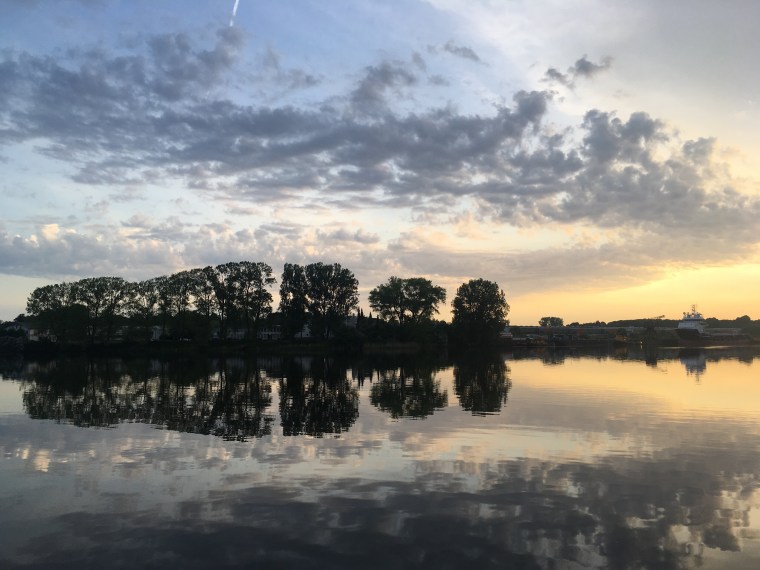
Als Scully den USB Connector erneut in den Zigarettenanzünder steckte, und nochmals durch alle nutzlosen Manöver zu gehen drohte, welche er bereits zuvor ohne Erfolg versucht hatte, fuhr ich zur Seite, hielt den Wagen an und stieg aus. Ich schloß die Fahrertür sachte hinter mir und machte ein paar Schritte in den frühen Abend hinein, der mich lauwarm und feucht empfing. Am Horizont verdichtete sich violettblauer Dunst zu Regenwolken. Auf den Feldern standen Schafe in gefälligen Abständen zueinander. Zwischen den Wolken leuchtete der Abendhimmel in hellgelben Streifen. Dort war Westen, dort lagen die Deiche und das Watt. Es war nicht mehr weit. Ich lehnte mich an die Kühlerhaube und sah dem Himmel beim Malen zu. In meiner Tasche steckten zwei Din-A 4-Zettel mit ausgedruckten Wegbeschreibungen.
Our physical body, all flesh and blood, rhythm and heart beat, clockwork and sensory organs, defines the outer limits of where we are at this moment, gives the coordinates of our place in time. It also obeys the limits defined by space and time, it is as vulnerable as it is capable of adaption to a wide range of defining circumstances we perceive as exterior. What a strange thing it really is to behold: to see oneself directly, not mediated by a mirror or a picture taken, but to observe ones fingers, hands, arms, legs and feet in motion, knowing that this very motion has its source in the observing brain but can still be observed as if acting independently from that brain that, at the moment of observation, denies all knowledge of its own doing to itself, a great puppet master.
Wir kauften ein kleines, überteuertes Stück Land von einem Bauern. Den Preis dafür hatte Scully über ebay ausgehandelt. Grünland. Das Land lag im Nirgendwo, nicht nahe der Küste, nicht an einem See oder am Waldesrand. Es war kein Bauland und würde, soweit es absehbar war und das deutsche Baurecht nicht drastisch geändert wurde, niemals Bauland sein. Es lag im Außenbereich unter einem niedrigen Himmel und war bar jeglichen Attributes, das es als attraktiv für auch nur entfernt touristische Zwecke zweier landhungriger Städter hätte geeignet erscheinen lassen, aber Scully lachte zufrieden, als der Notar uns nach der Beurkundung die Hand gab. Einige Wochen später waren wir im Grundbuch eingetragen, zu ideellem Miteigentum. Wir hatten eine Wiese gekauft, und einen Knick, der zu einer gut befahrenen Landstraße hin lag und im nächsten Frühjahr würde geschnitten werden müssen.
Der Winter war nass und warm gewesen und der Grund hielt jetzt so viel Wasser wie ein Schwamm, weil nichts mehr ablaufen konnte. In einer Senke ziemlich in der Mitte des Grundstücks hatte sich das Wasser an der Oberfläche gesammelt und einen kleinen Teich gebildet. Der Teich war im letzten Sommer nicht hier gewesen, als Scully das erste Mal über die Wiese gestiefelt und ich ihm wie ein kleiner Hund hinterher gehechelt war. Ja, das ist es, hatte er fachkundig festgestellt, genau hier muss es sein. Das war im Spätsommer gewesen, die Wiese war trocken gewesen und verkrautet und verwaist. Aber jetzt hatten wir auch einen Teich, jedenfalls vorübergehend, eine glatte Wasserfläche in der Geest, in der sich der Frühjahrshimmel spiegelte. Zu ideellem Miteigentum. Auf dem Teich schwammen zwei große Eiderenten, Somateria mollissima mollissima, die vielleicht Rast auf dem Weg zur Küste einlegten. Deshalb wirkte unsere Wiese jetzt nicht mehr so verwaist wie bei unserem ersten Besuch, und es war sehr hübsch, wie sich der Himmel in der Lache spiegelte, auch wenn von Zeit zu Zeit ein Lastwagen auf der östlichen Landstraße vorbeiknatterte.
Scully hatte den Wagen auf dem Wirtschaftsweg geparkt, wir waren ausgestiegen und hatten unsere Gummistiefel angezogen und Scully hatte mir die Thermoskanne in die Hand gedrückt und dann war es so weit gewesen: Wir schritten unsere Wiese ab, Scully mit dem schweren Schritt eines Grundbesitzers, der sein Land kennt, obwohl er in Hamburg-Altona in einer Zweizimmerwohnung lebte. Es war so: Scully schritt und ich machte einen Schritt, blieb stehen, sah mich um und hastete ihm dann hinterher, die Thermoskanne in der Hand, und so vermaßen wir die ganze Wiese, in der mein bescheidenes Erbe und sein Know-how steckten. Sein Wissen, mein Geld. Eine Wiese, auf der man nicht bauen konnte.
Als wir zum Gatter zurück kamen, reichte ich Scully die Thermos, er schraubte sie auf, goss etwas Tee in den Schraubdeckel, nahm zwei Schlückchen und reichte mir den Rest. Der Tee war schlierig und schwarz, wirklich schwarz, denn Scully machte keine halben Sachen. Der bittersüße Geschmack blieb einem noch lange im Mund, es war nicht jedermanns Sache. Weit entfernt von einem Flat White oder einem Cafe crema to go. Nichts für Anfänger. Der Tee belebte Tote.
Scully stand breitbeinig am Gatter und sah noch einmal sichtlich zufrieden über die Wiese. Wir brauchen ein Pferd, sagte er. Und noch eins zur Gesellschaft. Ich widersprach nicht. Es war noch etwas Geld auf dem Konto. Scully schien wie immer aus einer Eingebung zu sprechen, aber ich war mir sicher, dass er schon wusste, wo wir das Pferd, das er meinte, finden würden. Und eins zur Gesellschaft. Ein altes Pferd, für mehr reichte das Geld nicht. Oder ein lahmes. Oder ein altens und ein lahmes. Ich wusste nicht, weshalb wir ein Pferd brauchten und eins zur Gesellschaft, zu ideellem Miteigentum, aber wenn Scully es sagte, musste es so sein.
Once upon a midnight dreary, while I pondered weak and weary,
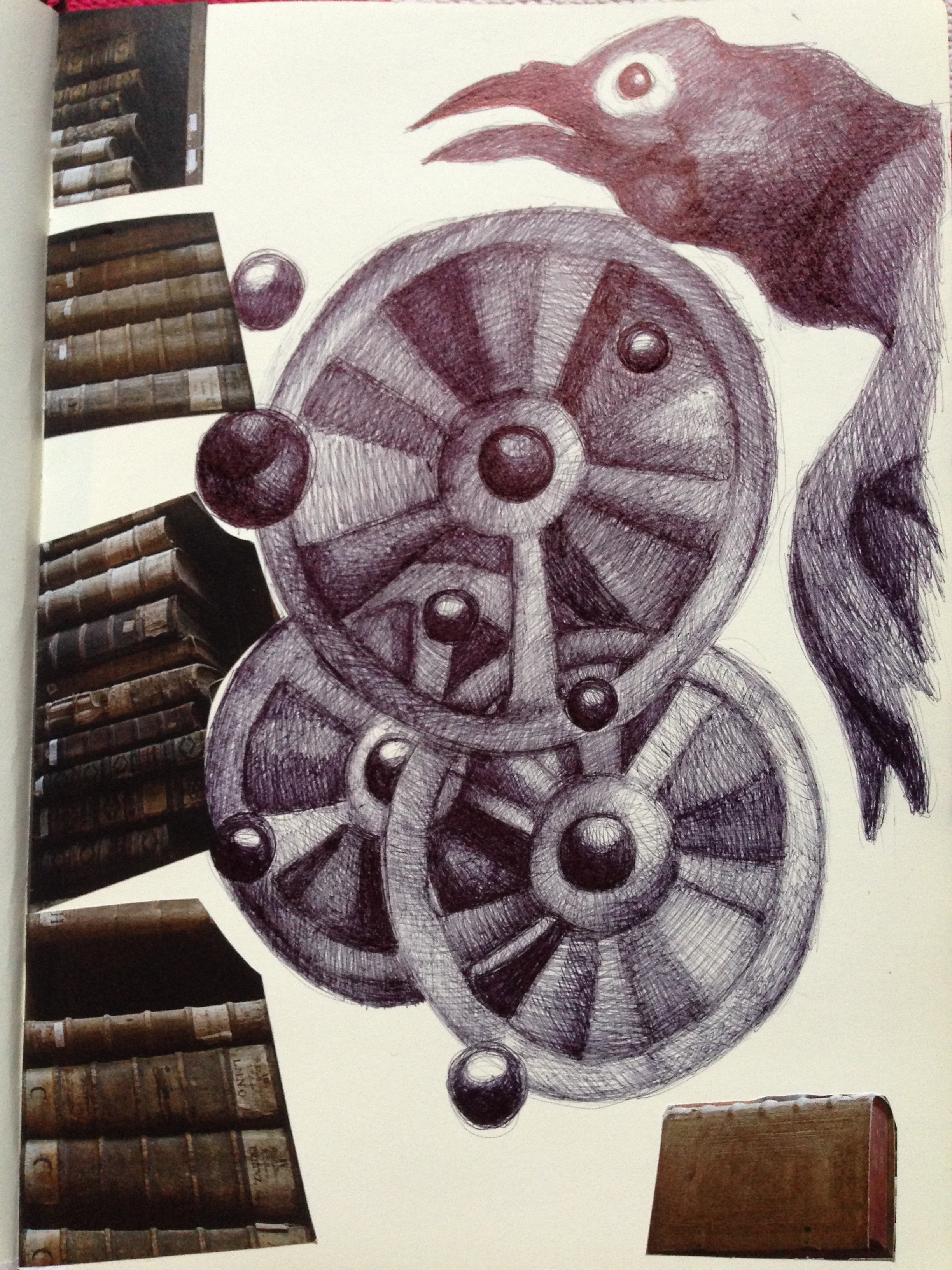
Over many a quaint and curious volume of forgotten lore …
I couldn’t make this the twelfth night theme. “Nevermore” is not the note I’d choose to conclude this season’s “Twelve Nights”. But on the eleventh night it brings together further elements of reading, words, images evoking coherent comprehension beyond words, night time, magic realism, dreams, illusions, delusions, sleep deprivation, time, meditation, past, progression,automatons, determinism, choice, knowledge, intuition, desperation, endurance …
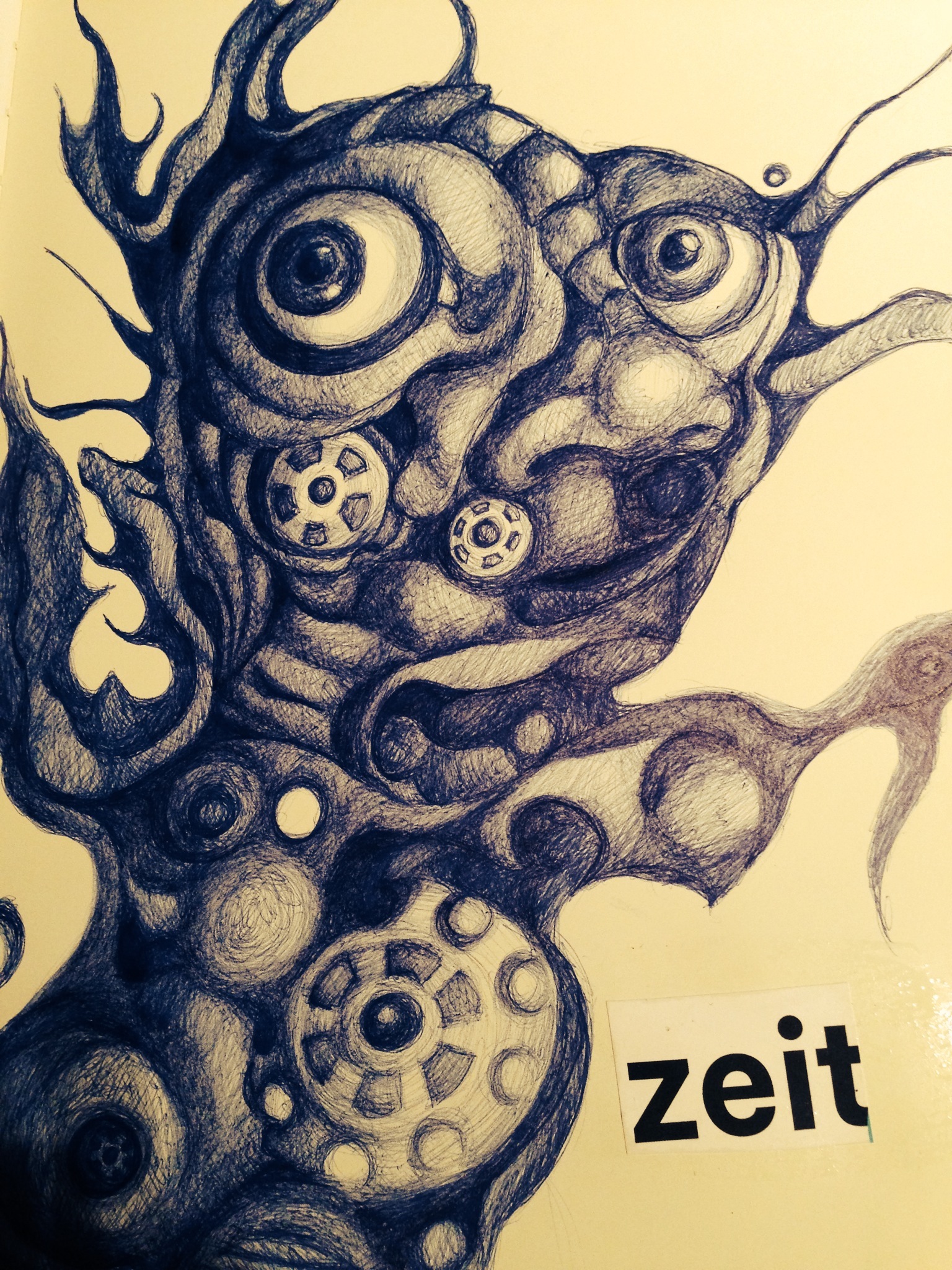
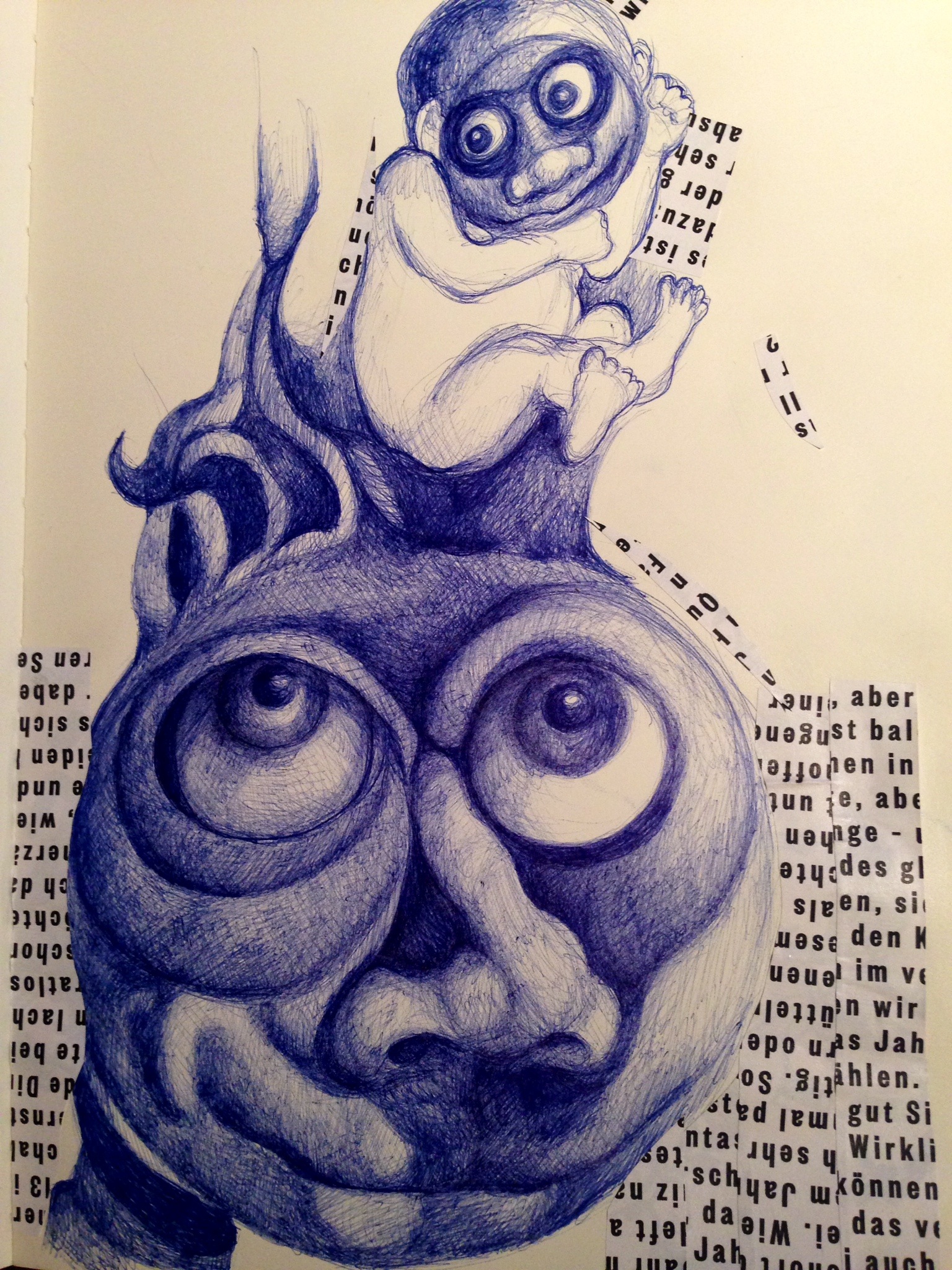
Two weeks ago I listened to a musician on DRKultur (radio) talking about time and about the experience of time during extemporaneous composition and performance on the piano. He talked about experiencing eternity not as an endless repetition of events in a space of time never ending but about as an experience of time being suspended. I think about art – writing, painting and illustrating – as taking place in just that space of time being suspended, a space that I can enter and where I can linger at will.
English: Spectrum of helium (Photo credit: Wikipedia)
or: when will we start to harvest the moon …
surprising studies show that if the anti-venom of bureaucratic correctness is not injected in time and the victim instead continues to breathe slowly through the nose, the seemingly alarming condition develops from a hallucinatory episode to a temporal ability to find one of the hidden doors into the helium-3 universe. the first sign of this conversion from the three-dimensional limitation into a full comprehension of the “it” including helium-3 is a steady stream of blue light from the nostrils. this oscillating string of conscious matter should not alarm the victim nor bystanders as it is not a loss of matter but a reconfiguration of the same. slightly nasal intonation after readjustment not uncommon but overall harmless. for reassurance the progress of the victim’s condition can be measured at a frequency of 8.665 GHz (3.46 cm), which is emitted naturally by ionized helium-3. the comprehension of the fact that most of the matter in the universe is non-baryonic, that is to say not made of any subatomic particle that include neutrons and protons, and that this matter is thought to be the primary source of gravity recording the constellation of the universe like the grooves on a record record a song, allows the observer to deduct from the state of rapture that the poisoned mind is – for a moment – privy to nothing less than a fusion of dark matter with consciousness, the first music of time.
an intervention at this point seems not indicated.
from: the dictionary of lifeforms on Helium-3 and other insignificant by-products of music-poisoning
It might just be true that there are some words that own us before we even truly know them.
A long time ago, I was a kid still, I watched a spy movie. I don’t even know the title of that movie now nor do I remember the plot. I seem to remember the face of the main actress but do not know her name. I just recall that the story unfolded around a group of so called “sleepers”, people who were leading normal average US citizen lives until they were called – by phone – by a contact person who then “woke” them to perform a certain task by reciting a single line from a poem to them. And this single line from a very famous poem stayed with me for years. Alas, neither did I know it was famous, nor did I initially know that it would haunt me for many years.
To make things more difficult, the movie was American synchronized to German. The time must have been late Seventies, I guess. None of these fragments of information enabled me to identify the movie.
The line as that came to haunt me was: “Des Waldes Dunkel zieht mich an, doch muss zu meinem Wort ich stehn und Meilen gehn’ bevor ich schlafen kann, und Meilen gehn, bevor ich schlafen kann.” I was immediately electrified. It was as if I had been woken up. The line stuck. After a few days I knew that I longed to learn the whole poem.Eventually, and maybe only a lover of poetry gets this, I longed for the poem the line was taken from like I would learn to long for a certain person much later on – but just not quite then.
Alas, there was no mentioning of the title of the poem. Nor of the author. I didn’t know what it was that electrified me. It was well before one could start an internet search. So I had to nurse that longing. And marvelously I did. For years actually. I never forgot those lines. Even though they might be among the most famous last lines of any poem ever written, I didn’t find them for a long time. It might have been easier had they been first lines though.
The translation of these lines, of course, is: The wood are lovely, dark and deep, but I have promises to keep, and miles to go before I sleep. And miles to go before I sleep.
We finally found each other, that poem and I, some twenty years later. And I was as happy as if someone had revealed my fate to me. And the revelation of that fate would have been to know the poem. The woods are lovely. It took about three minutes to learn the rest of the poem when I found it. I knew I had known it before I had known it. I knew it when I found it.
And I have no answer as to how it can be that a poem, a poem not even in my then native language came to claim my allegiance. Came to claim me.
The poem was written by Robert Frost. I am a sober person but this poem was written into my genetic make-up. It seems that I had always known it, that it had been waiting for me, patiently, all these years, even testing me.
This is a kind of respectless approach to the great poet, forgive me, Mr. Robert Frost, respect less in the sense that, of course, this poem is not individual, and that is where its true beauty lies.
Robert Frost, a poet who died before I was even born. But not long after, in a small book store in the Upper, upper east side, around 95th street and Lex, I had discovered a kid’s illustrated version of “Stopping by the woods”, stumbling upon it, virtually, I met an old photographer, a neighbor of mine on 95th Street and Columbus, Jacob Lofman. In his apartment there was a beautiful picture of Robert Frost that Jacob Lofman had taken years before. I know now that the picture was well known by the time I spotted it on the walls of the humble apartment in the Upper West Side when Jacob had invited me for tea.
Well known that foto might have been and still is, but it wasn’t to me back then. It was still not part of my culture. Robert Frost in New England. And so it came that I had the great pleasure to discover this image, the image of Robert Frost, in the apartment of a photographer who knew how to look at a man who by the time he met him was already legend and still to show something deeply personal about him.
I kept looking at the picture for a long time. Jacob made tea and I looked at the picture. I still can hear the water boiling, the tea cups cluttering. It made me happy to just look at the picture hanging on a wall in an apartment in the Upper West Side. In my ignorance I didn’t know that the man in the picture was famous. I knew by then, just for a few days, that he had written the poem I had searched for ever so many years. I don’t know why it was that poem by Robert Frost any more than you could answer why you love a certain person and not another.
I still don’t know why words have that kind of power. I just know by fortunate experience now that they do. I have rarely been as happy in my life as when I discovered those fragile bonds to a poem that had claimed me so many years ago. I know now, of course, that EVERBODY and their neighbors love “Stopping by the woods”. I guess that’s how it ended up in a spy movie. But without any cultural context, even without the context of the poem, just by a few lines in translation, spoken a few times, these lines had been truly powerful.
Life is strange, complex, opaque, but still we can establish part of its truth. We just know it when we see it. Truth claims us. Words have that kind of sober, relentless, inconsequential power. They are an end in themselves, no further salvation promised or needed.
the third night was bitter cold. eliminating useful words seemed an appropriate strategy to survive the moments that passed with uninterpreted certainty until about five minutes after midnight when the terror of the imaginative mind took over with an ease that betrayed its uncontested reign held even when the discipline of the mind seemed to have hold at bay the monsters lurking in the dark. the useless words i was left with after having eliminated the useful ones had painted beautiful, inconsequential shadows into meaningless days but the reign of the imaginative mind illuminated just a stretch of the way into the darkness, far enough to lead me further astray. but why should i have obeyed the categorical imperative and follow a chilling truth dedicated to a purpose i did not condone even if i couldn’t escape its gravity, a truth i won’t deny, not even now, a truth that with precision etches letters of sober inquiry into my mind but does not not compare to the shimmering beauty of my ordinary lies five minutes after midnight.
English: Immanuel Kant Deutsch: Immanuel Kant (Photo credit: Wikipedia)
 Eventually Scully´s door opened, too. He pushed his heavy frame out of the car and slammed the door causing a few sea gulls to swoop up in unison and to quickly synchronize their flight. I watched them enviously not so much for their ability to fly but for their effortless communication. Scully placed himself right next to me, leaning onto the VW front with some of his weight. For once he was quiet. Hard to say if it was just because his rage, which predictably flared up whenever things didn’t go as planned, had burned out, or whether because he had noticed the colors, the smells and the creatures eyeing us from all directions and enjoyed them. I couldn’t say. He had found a map in the glove compartment. It didn’t cover the area. He had also found the article I had written for the health blog and had planned to reread before submitting it. I would have actually been surprised if Scully had asked for my permission to read it. For Pete´s sake, a few hundred people might read it, why not Scully. He waved it like a white flag. Did you write this, he asked, matter of factly. I continued to study the birds’ flight. He unfolded the sheet all the way and started reading out loud, though in a low voice, not actually mocking me, which kind of surprised me:




 Art & Writing